The Morton Motor Company Mongoose
A single donor mid-engine sports car that reinvents a British classic

A single donor mid-engine sports car that reinvents a British classic
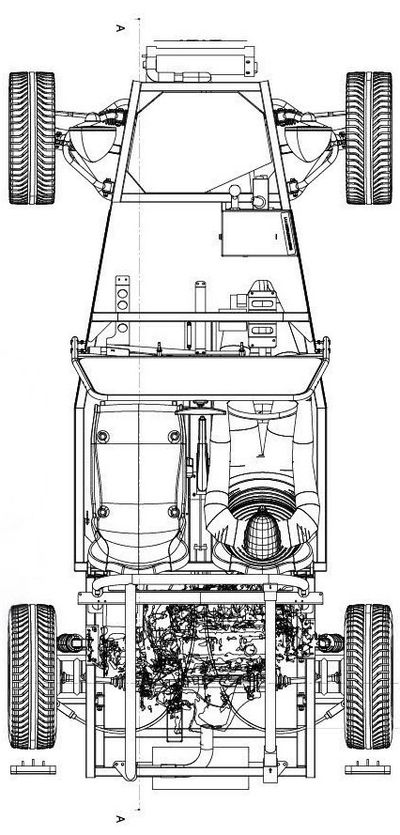
A mid engine design optimises the vehicle's weight distribution between each wheel which makes the best use of available grip. The slight rearward weight bias of a true mid engined design gives light, agile but communicative steering.
A true, rather than front, mid-engined design locates the vehicle's major masses as close to the car's rotational axis as possible, minimising resistance to changes in direction. To put it another way, it's easier to turn a dumbbell if the crossbar is shorter.
More weight over the driven wheels means faster starts and better traction through corners, even without a limited slip differential (although this is an easy upgrade).
A typical front or mid-engined transaxle weighs less than an equivalent rear wheel drive gearbox, propellor shaft and differential.
Modern front wheel drive packages lend themselves readily to a mid-engine location, and mechanically healthy mark seven Fiestas are available for a few hundred pounds. You may even recoup this cost by selling the leftovers.
In a traditional front-engined sports car the driver's feet are often competing for space with the gearbox. The mid-engined layout avoids this problem, so the Mongoose can be driven in size 12 boots.

The Sigma drivetrain was 3D scanned and the smaller Fiesta parts were drawn in CAD. The chassis was developed using this data and a 95 percentile mannequin along with real life full size ergonomic bucks. Safety, simplicity, ease of construction and torsional rigidity were key drivers.
The Fiesta donor parts bolt to laser cut bracketry manufactured to an accuracy of 0.1mm, allowing a straightforward and rewarding build.
Despite the apparently simple design, the use of 40x40 box section tubes, strategic local reinforcement and relatively thick 3mm aluminium panels makes the chassis approximately three times stiffer than a standard Seven design. Bonding and riveting the body to the chassis and adding the roll bar will improve this figure further. The slight weight penalty is offset by the lighter mid mounted drivetrain.
Unfortunately, the Fiesta upright was found to be unsuitable for use in the Mongoose, so bespoke front and rear uprights were developed that retained the Fiesta hub and braking system.
Double wishbone suspension is used front and rear to maintain tyre contact with the road during roll whilst maintaining a stable roll centre. Further CAD analysis was used to minimise bump steer and driveshaft plunge. The design is again relatively straightforward to manufacture, creating cost savings that can be passed on to customers.
Although the chassis can be supplied powder coated we suggest that customers transport the chassis uncoated then have it blast cleaned and painted with two pack truck bed liner once the build begins. This is a very durable coating, and can be easily touched in when the inevitable nicks and dings happen during the build and in service

A 3D CAD model of the bodyshell was developed around the chassis CAD, a 3D scan of the Fiesta drivetrain and a 95 percentile male mannequin. The rear body, side panels and scuttle are moulded in one section, which is designed to clip under the lower chassis rail to hold the body snuggly in place.
The one piece boy buck was CNC milled from polystyrene to ensure perfect symmetry and an accurate fit to the chassis. Separate forms for the nose cone and bonnet were 3D printed. This approach meant that surfaces that would typically be flat in a traditional Seven could be given a slight curvature and crown, which improves stiffness and r
The one piece boy buck was CNC milled from polystyrene to ensure perfect symmetry and an accurate fit to the chassis. Separate forms for the nose cone and bonnet were 3D printed. This approach meant that surfaces that would typically be flat in a traditional Seven could be given a slight curvature and crown, which improves stiffness and rigidity. Many hours of filling and surface preparation followed.
Once the bodyshell is bonded and rivetted in place the bonnet and nosecone can be fitted and aligned. The front wings are then simply bolted to the front suspension uprights. The whole process should take less than a day to complete.

This is the Fiesta before the "Aston Martin" front grille appeared that retained the Yamaha designed Sigma engine, more of which later. This version is sometimes confusingly referred to as the Mark 7 in the UK, so it is worth shopping by year to avoid confusion. Later versions following a 2012 facelift used the troublesome EcoBoost engine.
Wherever possible the donor parts are reused. Sometimes this is straightforward, occasionally some ingenuity is required, but inevitably some donor parts are so far from ideal that to use them would be a compromise too far. The Fiesta uprights, steering rack, fuel tank, radiator, pedals, heater and seats were all considered, but in the end replaced with more appropriate items. As you may have gathered, this leaves a very long list of parts that can be transferred from your donor, saving thousands of pounds in aftermarket alternatives.
Our donors use the normally aspirated, lightweight aluminium Sigma engine. It was designed by Yamaha so provides an authentic sportscar driving experience in it's new home, with instant revs rather than turbo lag. In the Fiesta It's capacity ranges from 1.25 to 1.6 litres, the latter sometimes equipped with variable valve timing to produce 120bhp, which in a 500kg sportscar is more than adequate.
The IB5 gearbox has been used in small Fords for decades. The Mongoose reuses the donor gear shift cables with a new lever mechanism. The concentric clutch slave cylinder is retained, but is operated by a new, more compact master cylinder and pedal system. The standard length driveshafts are also used without modification, with the engine precisely located to minimise driveshaft plunge.
The IB5 and IB5+ gearbox was also used with the Zetec E and Duratec L 1.8 and 2.0 engines in the earlier Fiesta Mk 5 ST150 and contemporary Focus and Mondeo. These engines have a different bell housing bolt pattern to the Sigma engines, but can be used in the Mongoose with the engine specific IB5 gearbox. Ford's approach to engine nomenclature was highly confusing, with the term Duratec applied seemingly at random, so please contact us for a chat if you would like to pursue this option. We may well persuade you that the Sigma engine makes perfect sense...
The Fiesta wiring loom is beautifully made and as most of it lives inside the donor car, will be in perfect condition. Apart from remaking connections to the external lighting it can be transplanted into the Mongoose as a complete unit, so that the factory instruments, switches, wiper motor, screen-washers, horn, immobilizer and ECU can be reused.
The Fiesta induction system, in tank fuel pump and tank sender are reused, although the fuel tank is an awkward shape and had to be replaced with a bespoke unit that fits within the confines of the Mongoose body.
The bespoke front hub uses the Fiesta front brakes and rear bolt on hub. The bulky Fiesta rear mounted steering rack is replaced with a front mounted classic Mini item, which connects to the de-motorised Fiesta column via a new extension shaft. Alternative track rods, track rod ends and upper and lower ball joints more suitable for the double wishbone front suspension will be supplied in the kit.
The Fiesta servo assisted master cylinder is replaced with a non assisted item and a new, shorter pedal for a traditional sportscar pedal feel.
The rear drum brake is sandwiched between the rear upright and a bespoke carrier that supports the rear wheel bearing and hub. This provides perfectly adequate rear wheel braking for normal road use and a very effective handbrake, although a rear disc brake conversion will also be available.
Or better still, please come and see us at our next show or open day.
